Switched vs. Shared Networks: How Full-Duplex Architecture Eliminates Collisions
Introduction
Legacy vehicle networks like CAN, LIN, and FlexRay rely on shared bus topologies where every connected node shares a single communication channel and must take turns transmitting data. Modern Automotive Ethernet replaces this shared bus paradigm with a switched, full-duplex architecture that fundamentally transforms how data moves within the vehicle.
Full-Duplex Operation over Single Twisted Pair
- Simultaneous Send and Receive: Full-duplex operation enables two connected devices to transmit and receive data at the exact same time over a single twisted pair of copper wire.
- Eliminating Turn-Taking: Unlike half-duplex shared buses where nodes must wait for an idle channel, full-duplex links eliminate channel contention between paired devices.
- Doubled Aggregate Link Throughput: Simultaneous bidirectional transmission doubles the theoretical throughput of the physical link—yielding up to 200 Mb/s of total bandwidth on a 100 Mb/s 100BASE-T1 connection.
- Foundation for Time-Sensitive Traffic: Continuous, collision-free full-duplex links provide the predictability required for advanced protocols like Audio Video Bridging (AVB) and Time Sensitive Networking (TSN).
Packet Switching and Aggregate Network Bandwidth
- Frame-Based Switching: Communications are broken into discrete messages called frames. Ethernet switches contain specialized hardware to handle incoming frames from multiple senders and forward each directly to its intended recipient.
- Simultaneous Conversations: Because links between nodes and switch ports are independent, multiple node pairs can conduct simultaneous data exchanges across the network without interfering with each other.
- 400 Mb/s Aggregate Example: On a 4-node 100BASE-T1 switched network, if ECU1 communicates with ECU4 at 100 Mb/s in both directions while ECU2 communicates with ECU3 at 100 Mb/s in both directions, the total aggregate network throughput reaches 400 Mb/s.
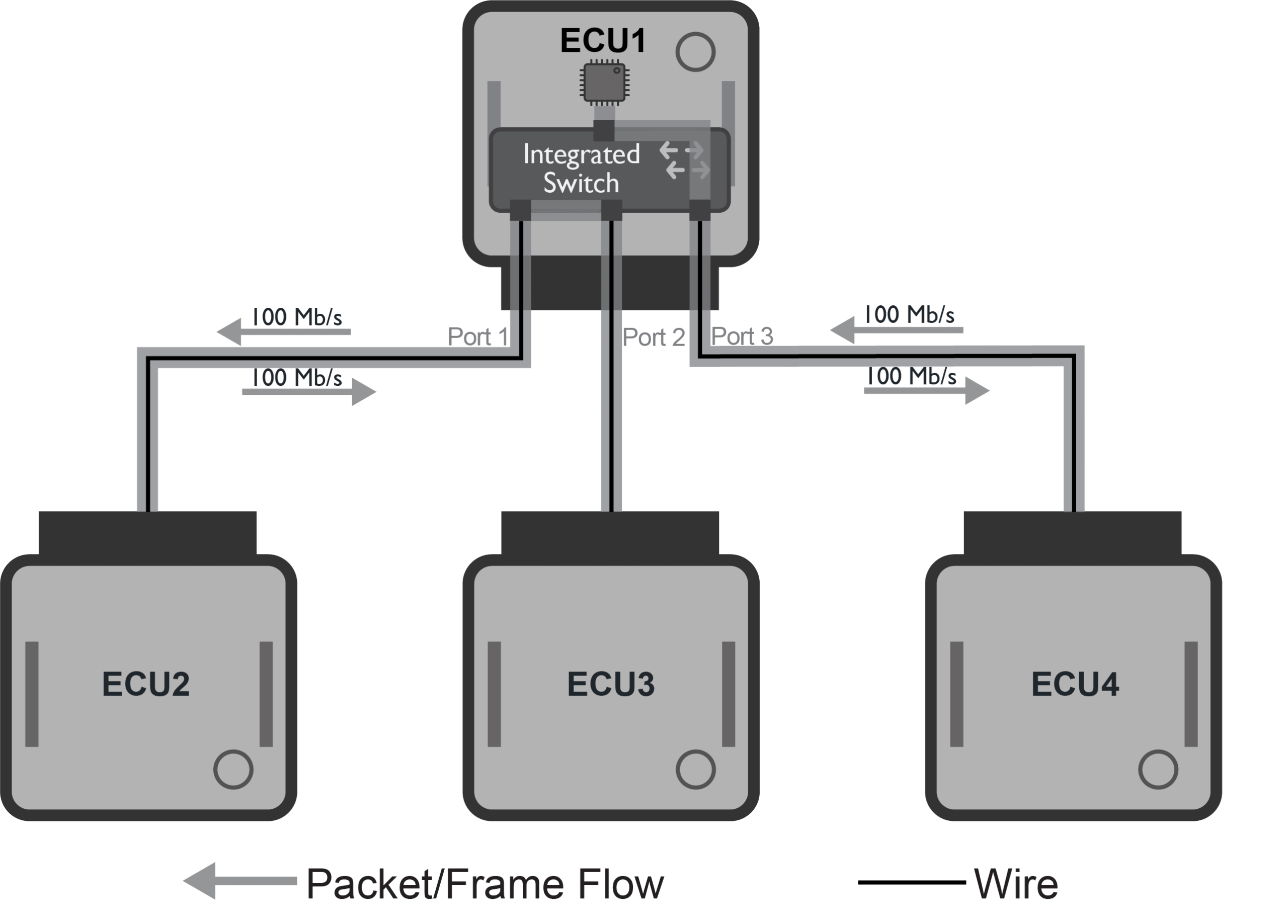
Packet-Switched 100BASE-T1 Network Supporting 400 Mb/s Aggregate Bandwidth
Address-Based Messaging and Flexible Network Scalability
- Explicit MAC Addressing: Every Ethernet frame contains a designated source address and destination MAC address.
- Transparent Switch Operation: Switches read destination addresses to forward frames automatically to the correct output port without modifying message contents.
- Seamless Topology Changes: Because frame routing is managed transparently by switch hardware, network engineers can reconfigure ECU placements or insert additional switches to expand the network without requiring ECU software stack modifications.
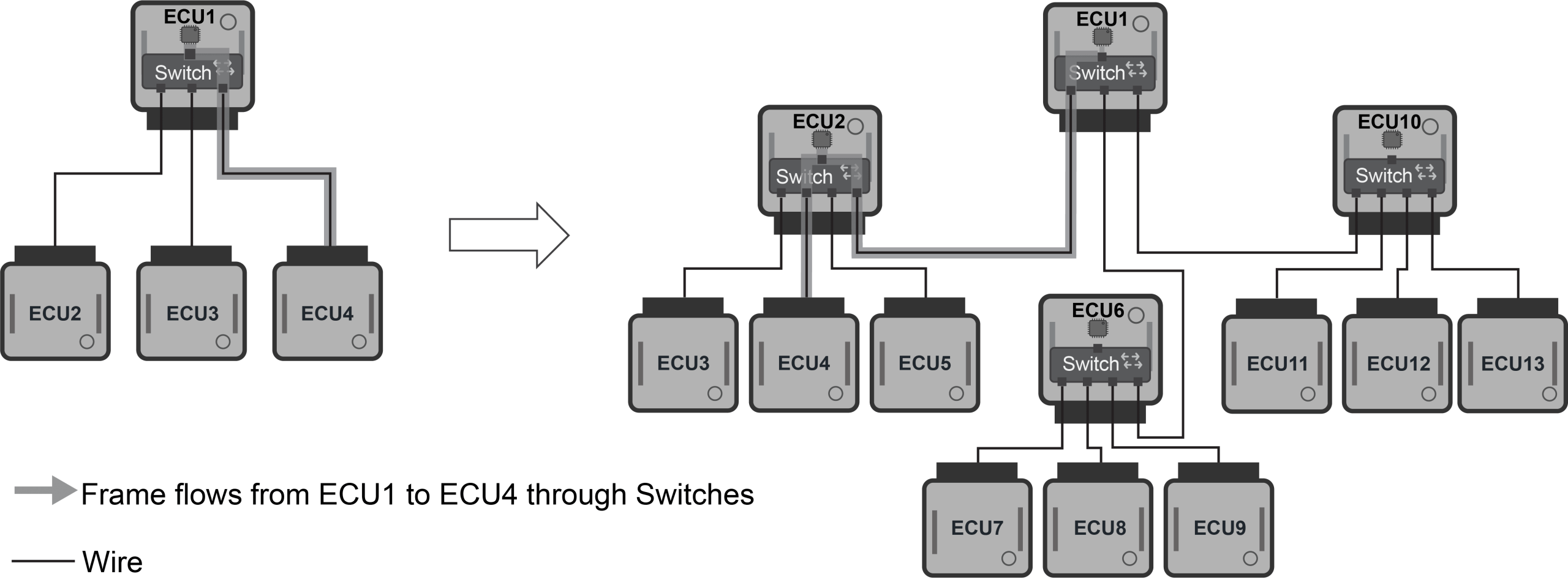
Flexible Switched Network Topologies with Address-Based Messaging
Key Takeaway
Transitioning from shared buses to switched, full-duplex Automotive Ethernet eliminates channel collisions, scales aggregate bandwidth well beyond nominal link rates, and allows vehicle network topologies to expand without software reconfiguration.
Master Switched Automotive Ethernet Traffic Analysis
Tapping and analyzing full-duplex, switched Automotive Ethernet networks requires hardware built specifically to capture bidirectional traffic without introducing latency:
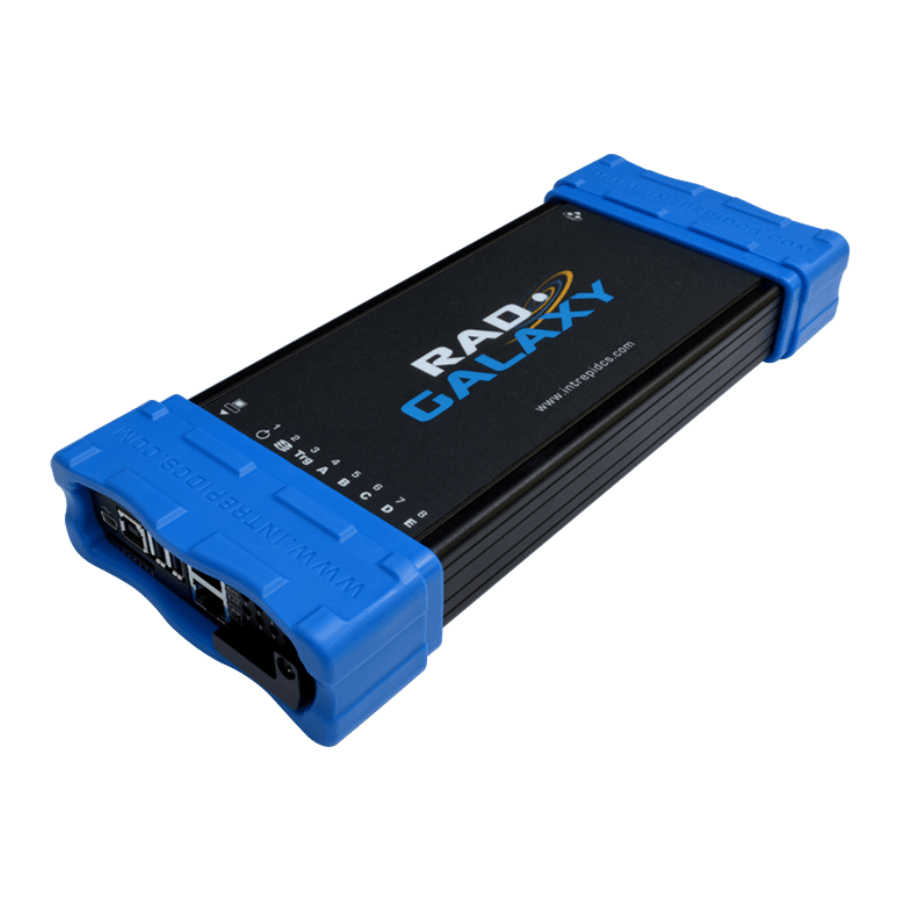
RAD-Galaxy Active TAP & Gateway
Actively tap up to 6 Automotive Ethernet links (100BASE-T1/1000BASE-T1) and 8 CAN FD channels with microsecond hardware timestamping.
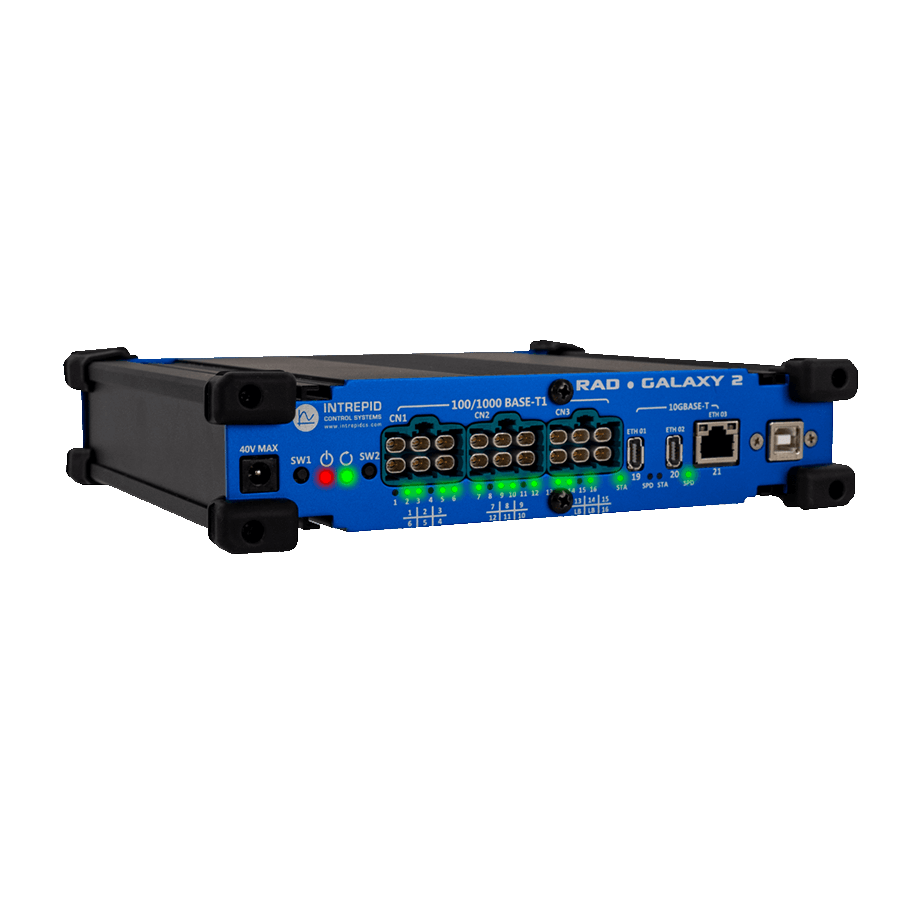
RAD-Galaxy 2 Active TAP & Gateway
Tap up to 8 Automotive Ethernet links (100BASE-T1/1000BASE-T1) with microsecond timestamping accuracy.
Vehicle Spy (VSpy) Software
Monitor frame-level MAC addresses, analyze switched traffic flows, and filter SOME/IP or DoIP protocols in real time.