
Why Automotive Ethernet? Key Advantages Over Legacy CAN Networks
Introduction
Introducing a new networking technology into the automotive industry is monumentally expensive, risky, and difficult because vehicles are expected to operate safely for decades while carrying precious human cargo. For over thirty years, in-vehicle networks operated separately from consumer electronics, relying heavily on Controller Area Network (CAN) technology created in the 1980s. However, the rapid surge in processing power driven by Autonomous Driving, Advanced Driver Assistance Systems (ADAS), electric vehicles, and infotainment systems has pushed traditional automotive networks past their limits, making Automotive Ethernet the foundational backbone for modern Software-Defined Vehicles (SDVs).
1. Unmatched Bandwidth Scaling and Future-Proof Layering
- When CAN was introduced in the 1980s, its 1 Mb/s nominal speed was sufficient, and modern CAN-FD improvements reach bandwidths approaching 10 Mb/s.
- Single twisted-pair Automotive Ethernet standards scale seamlessly from 100 Mb/s (100BASE-T1) to 1 Gb/s (1000BASE-T1), and up to 2.5 Gb/s, 5 Gb/s, and 10 Gb/s (MultiGBASE-T1).
- Ethernet preserves higher-level software and protocols through its strict layered networking model.
- By isolating physical layer changes at Layer 1 of the OSI model, low-level hardware can be upgraded from 100 Mb/s to multi-gigabit speeds without requiring developers to rewrite higher-layer software stacks like TCP/IP, SOME/IP, or AVB/TSN.
2. Full-Duplex Operation, Switching, and Address-Based Messaging
- Full-Duplex Operation: Unlike legacy shared networks where nodes must take turns transmitting, full-duplex Ethernet allows two linked devices to send and receive data simultaneously. This doubles theoretical aggregate link throughput—providing up to 200 Mb/s of total throughput on a 100 Mb/s 100BASE-T1 link.
- Packet-Switched Architecture: Modern switches route incoming frames independently across dedicated ports. On a 4-port switched 100BASE-T1 network, multiple simultaneous node-to-node conversations run at full speed, delivering up to 400 Mb/s in total aggregate network throughput.
- Transparent Address-Based Messaging: Ethernet frames use explicit source and destination MAC addresses. Switches automatically route frames based on destination addresses, allowing developers to reconfigure network topologies or add switches without requiring ECU software changes
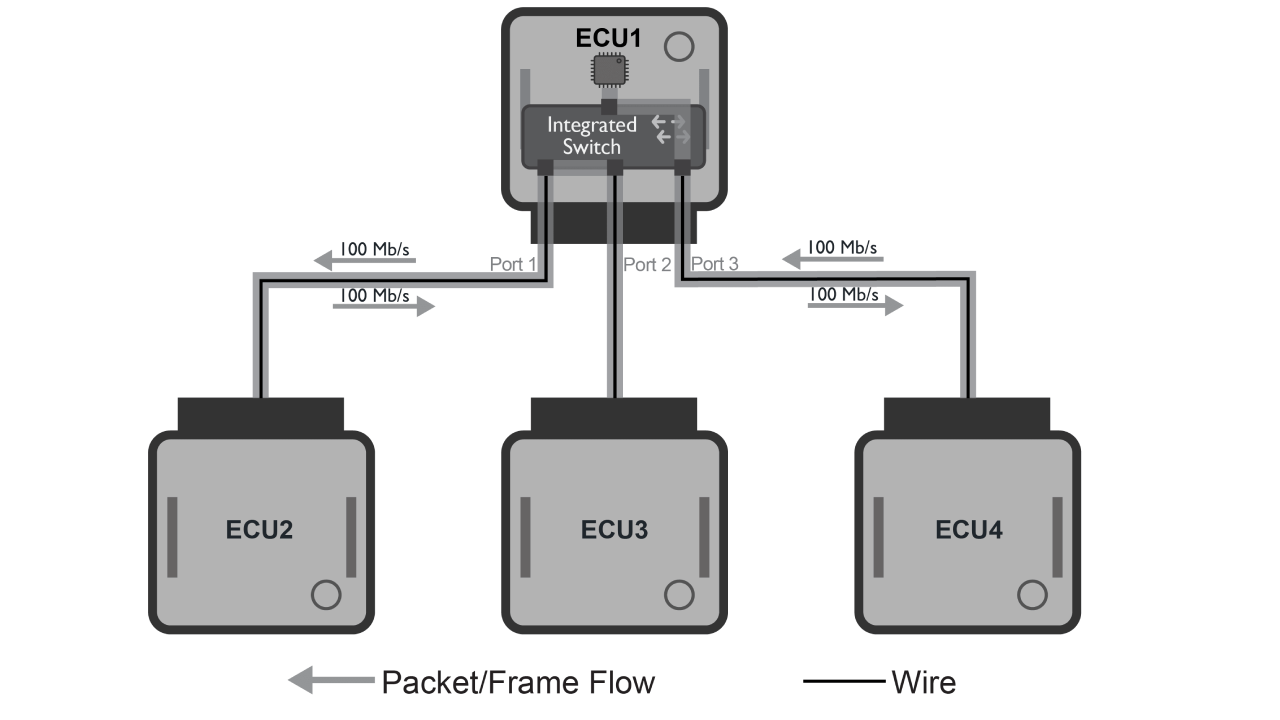
Switched 100BASE-T1 Network Supporting 400 Mb/s Aggregate Bandwidth
3. Significant Cost, Weight, and Physical Isolation Benefits
- Weight and Cost Reductions: 100BASE-T1 uses a single unshielded twisted pair (UTP) of thin copper wire, offering up to an 80% lower overall cost and a 30% reduction in cabling weight compared to older shielded Low-Voltage Differential Signaling (LVDS) connections.
- Inherent Electrical Isolation: Automotive Ethernet physical layer implementations adhere to strict transient voltage and Electro-Static Discharge (ESD) immunity standards, offering superior resilience in harsh electrical environments compared to CAN’s 4.5 V DC common-mode limit.
- Power over Data Lines (PoDL): Standardized under IEEE 802.3bu, PoDL carries DC power over the same single twisted pair that carries data, eliminating extra power cables to further reduce vehicle bill-of-materials cost and weight.
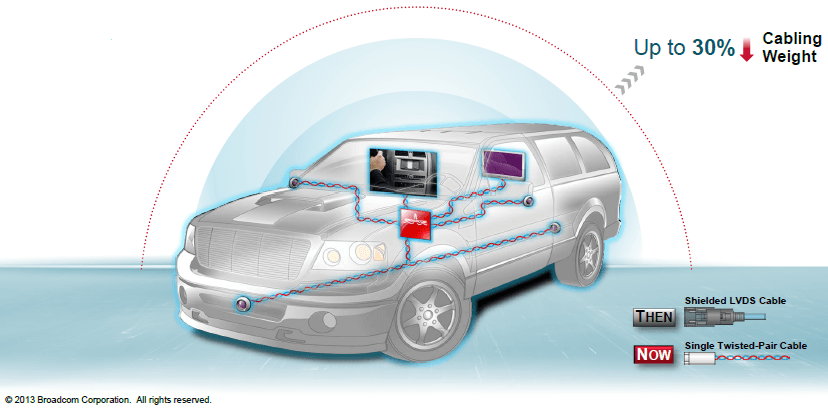
30% Cabling Weight Reduction: Shielded LVDS vs. Single Twisted-Pair Cable
4. Software-Defined Vehicles (SDVs) and Ecosystem Synergies
- Vehicle buying decisions are increasingly driven by software features such as active lane departure prevention, automated parking systems, and over-the-air (OTA) firmware updates.
- Electronics hardware and software now represent up to 45% of total vehicle cost in premium vehicles and are projected to reach 50% across all vehicles by 2030.
- Transitioning in-vehicle communications to standard Ethernet aligns automotive architecture with global IT standards, opening access to established protocol suites, battle-tested software tools, and a massive global pool of engineering talent.
Summary
By combining multi-gigabit speed scalability, switched full-duplex throughput, and lightweight single-pair physical cabling, Automotive Ethernet equips vehicle manufacturers to build safer, lighter, and fully software-defined connected vehicles.
Ready to transition your test bench or vehicle fleet to Automotive Ethernet?
Explore Intrepid Control Systems RAD-Moon Media Converters and RAD-Galaxy Active TAPs to capture, decode, and analyze 100/1000BASE-T1 and CAN FD traffic side-by-side using Vehicle Spy.
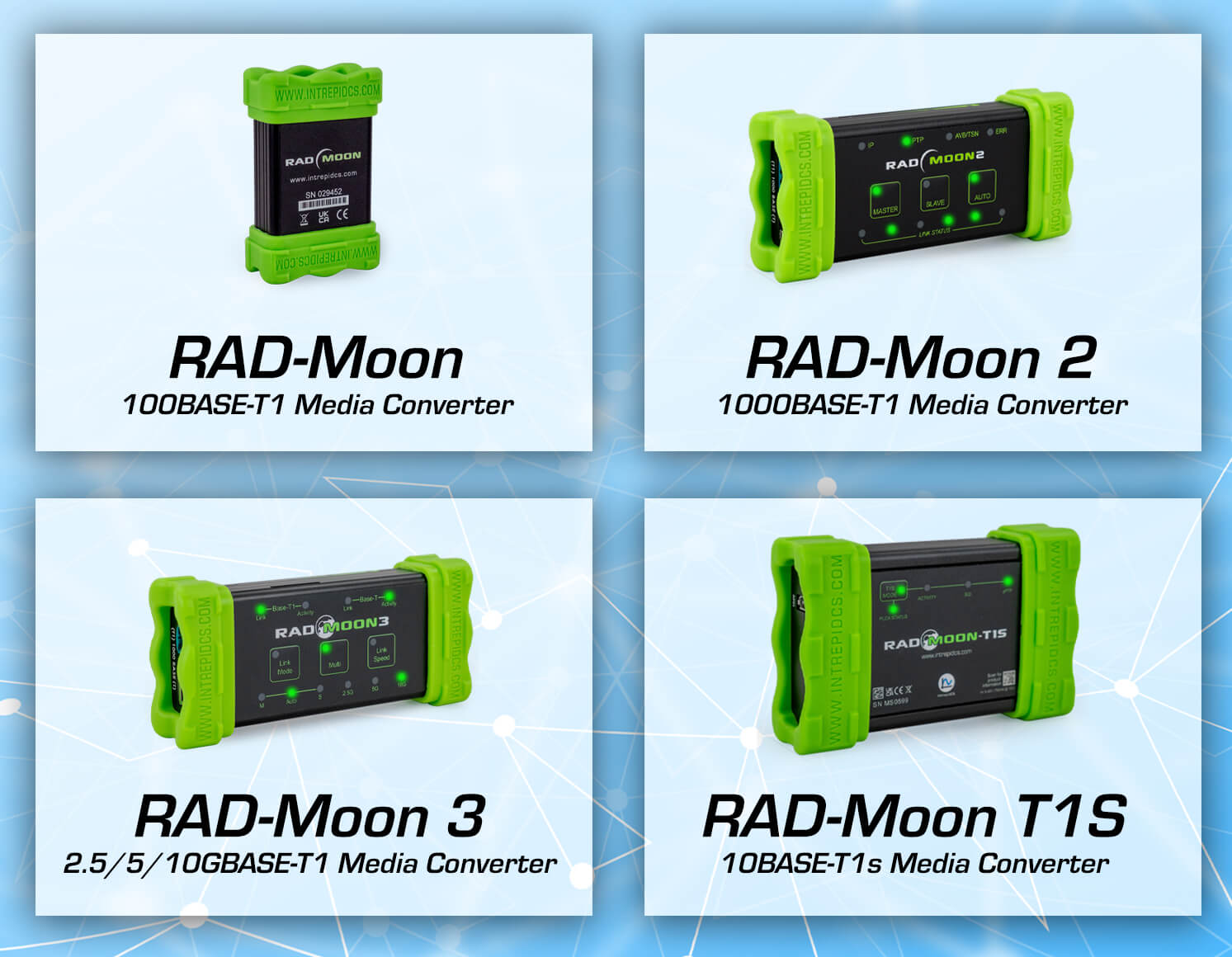
Automotive Ethernet Media Converters
Bridge the Gap Between Conventional and Automotive Ethernet.
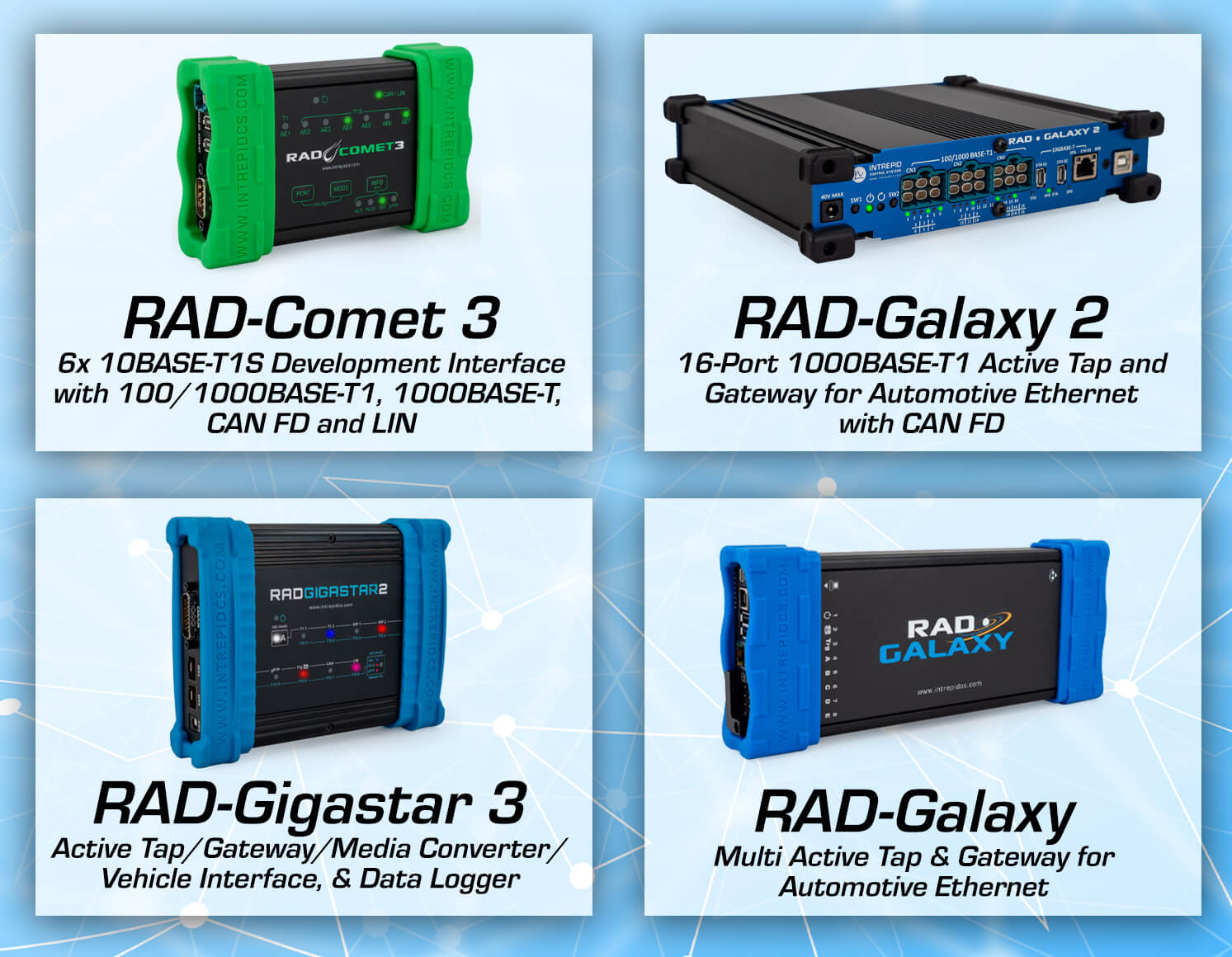
Active Network TAPs
Advanced tools for monitoring, testing, and analyzing Automotive Ethernet networks.


